House of Mystery
The Setup: A Ghost Chaser and His Audience
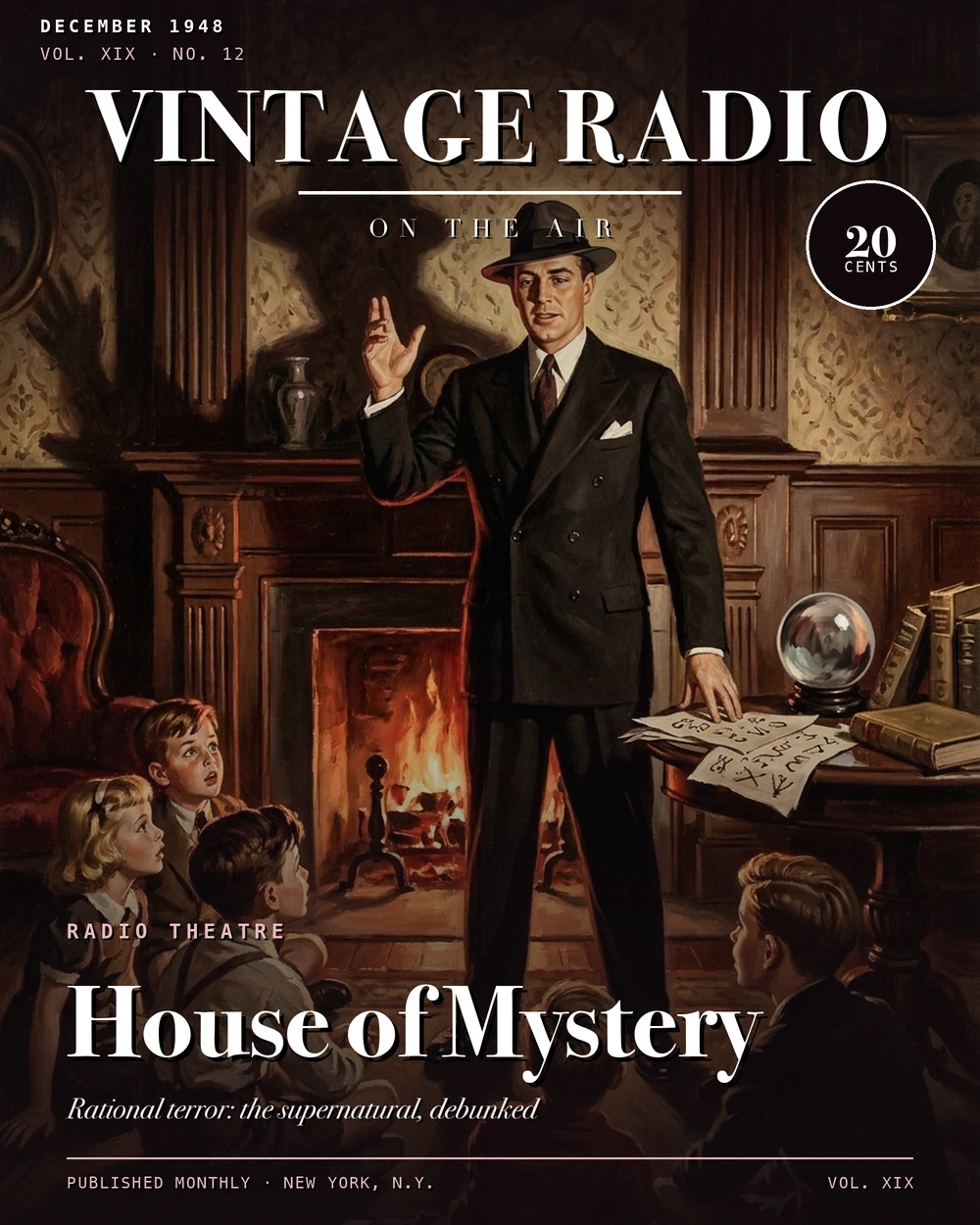
The premise of House of Mystery was simple and a little clever. A character called Roger Elliott — billed as "the mystery man" and described as both a ghost chaser and a scientist of the supernatural — hosted a fireside-style storytelling session for a group of children. At the end of each tale, the kids could ask him questions. Elliott's stated mission was to prove that "ghosts and phantoms exist only in the imagination," which meant every episode worked toward a rational explanation, even when the stories themselves were steeped in shadowy atmosphere. It was horror for children that reassured while it thrilled.
The show's opening made no bones about what it was. Creaky organ music by George Wright rose under the announcer's elongated hiss: "Thisssss is the Houssssse . . . of Myssssstery!" That stretched-out sibilance set the tone immediately — spooky enough to give you a shiver, but self-aware enough to let you enjoy it. The children in the framing device reacted with "ooohing and aaahing," which reinforced the playful, communal feel of the whole thing.
John Griggs played Elliott through most of the run, narrating each story in flashback before it was fully dramatized with a supporting cast and sound effects. Griggs had started on stage in Detroit, made his Broadway debut in a George Arliss production of The Merchant of Venice, and had broadcast for the Voice of America during World War II. He brought a calm authority to the role that made Elliott's rational debunking feel earned rather than dismissive. Later in the run an unidentified actor took over the part, though surviving sources don't pin down when.
How It Got on the Air
The show came from Bob Maxwell, born in the Bronx in 1908, who had a track record in children's radio that included The Adventures of Superman. The impetus reportedly came from a survey by Dr. Robert Thorndyke of Columbia University, which found that boys and girls across a wide age range "preferred supernatural mystery to any other format." Maxwell built the show around that finding.
House of Mystery first broadcast on Mutual on January 15, 1945, as a weekday serial in 15-minute episodes that began with an adaptation of Rip Van Winkle before settling into self-contained stories. That first run ended in May — not because it failed, but because Mutual needed the slot for Captain Midnight, which was moving over from ABC. When the show returned that September it came back as a Saturday noon program with 30-minute episodes, and General Foods signed on as sponsor. The third and longest stretch started in October 1946, when it moved to Sundays at 4 o'clock and ran continuously through December 25, 1949. General Foods stayed on through the entire Sunday run, promoting Post-Toasties corn flakes — described in commercials as "extra thin and tender crisp" — and encouraging parents to serve children "Wholesome Postum" instead of coffee. One notable detail of the show's commercial structure, praised by Radio Best magazine, was that ads ran only at the beginning and end of each episode, with no interruptions in the middle.
From there, episodes stuck to a recognizable formula: mysterious lights, vanishing footprints, things that went bump in the night, and a rational explanation waiting at the end. Occasionally Elliott inserted himself into famous ghost-lore stories, placing himself at the center of them in a style radiohorrorhosts.com has compared to Baron Munchausen. And at least once, reportedly, the supernatural explanation was left genuinely open-ended — atypical for the series, and memorable enough that OTR researcher Michael Ogden recalled it specifically.
The People Behind It
Frances Dexter produced the program, while Olga Druce directed. Druce's path to the show was unusually varied. She graduated from Smith College in 1931, then studied at the University of Berlin, the University of Munich, and the Max Reinhardt School in Germany, where she also acted in provincial theater. Back in the United States she began a Broadway career, appearing in productions including Judgment Day, Moon Over Mulberry Street, Eternal Road, and Time of Your Life. Critic Burns Mantle wrote that she "does nicely by the ingenue role" in Moon Over Mulberry Street. She eventually moved into radio writing — scripting health programs for prominent physicians, consulting on This Changing World, contributing to The Adventures of Superman — and worked her way up from writer to producer to director on House of Mystery.
Druce took the educational dimension of children's radio seriously. She spoke on the subject at the International Congress on Mental Health in London in August 1948 and lectured to the Massachusetts Parent Teachers Association on mental health. In November 1949, the Republic of Haiti recognized her with a luncheon and an award for using an episode of the show to help American audiences better understand Haitian culture — an unusual distinction for a mystery program aimed at children.
The studio audience of children that Elliott addressed each week was not, in fact, composed of children. The kids' voices were performed by adult actors, with Cecil Roy prominently featured in those parts. Roy — born Cecil H. Roy in St. Paul, Minnesota, in 1900 — was known in radio circles as "The Girl of a Thousand Voices" and had voiced Little Lulu in the Famous Studios theatrical shorts for Paramount Pictures between 1943 and 1948. She later voiced Casper the Friendly Ghost. Her ability to sound convincingly young was central to the show's framing device. Surviving episodes also credit Horace Braham, Vera Allen, Peggy Cunnigee, and Barry Kroger in supporting roles.
The Recognition It Earned
In 1946, the Ohio State Institute for Education by Radio gave House of Mystery one of 13 awards it distributed to national network programs during its 10th annual American exhibition. The citation was specific about why: the show "merits the award because it achieves the objectives essential in a program for children," crediting its entertainment value, dramatic quality, self-contained suspense resolution, and its message that "superstition and fear are based on ignorance." That last point was the show's real thesis, restated week after week in the form of Roger Elliott patiently explaining away the ghosts.
Radio Best magazine praised the show and singled out Druce for particular commendation, calling it "top-drawer entertainment for the kids and their elders, too." A scholarly article — "Therapeutic horror? Olga Druce, House of Mystery and the controversy over children's radio thrillers" — has since framed the program as an example of post-World War II child-centered programming that combined thrills with socially-enlightened content, situating it in the tradition of the collaboration between child education expert Josette Frank and Bob Maxwell that had shaped The Adventures of Superman. Radiohorrorhosts.com put it more plainly, describing House of Mystery as "sort of a forerunner to the Scooby Doo mystery formula, only without the dog or teenagers."
What Happened After the Radio Run
Bob Maxwell produced a television pilot for House of Mystery in 1954, with Irish-American actor Dan O'Herlihy taking over the role of Roger Elliott. The pilot was never broadcast.
John Griggs moved into television work, appearing on the Jackie Gleason program and the United States Steel Hour. He had a separate passion away from performance: film preservation. He collected 16mm prints of rare films and sold them under the company name Griggs Movie Drome. In 1965, two years before his death on February 25, 1967, he published an eyewitness account of the 1915 Eastland disaster in Chicago in American Heritage Magazine. After he died, Yale University acquired his extensive film collection — with funds raised by the Friends of Film at Yale, organized by Chester LaRoche with support from Frederick Beinecke and Richard Fuller — and it became the foundation of the Yale Film Studies Center.
Of the show itself, only four or five episodes are known to have survived. Among them are "Gift from the Dead," broadcast August 3, 1947, in which a widow believes she is haunted by her late husband and calls on Elliott; and "The Mystery of the Empty Chair," from November 7, 1948. For a show that ran nearly five years and produced a substantial body of work, the surviving record is sparse — which makes what remains worth hearing closely.